
Towards more responsible digital technology, combining innovation and sustainability
As the environmental and societal footprint of digital technology continues to grow, DEEP is committed to a responsible digital approach, with the aim of combining performance and sustainability.

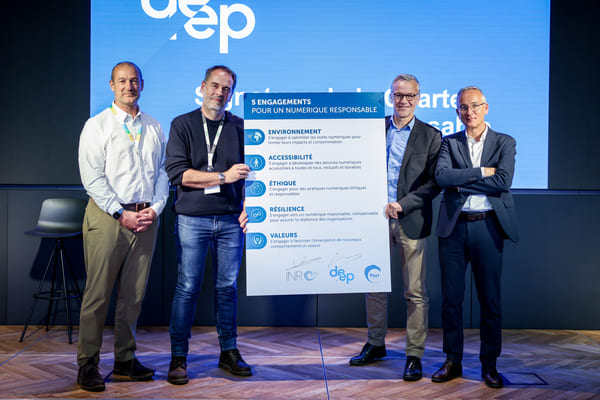
By signing up to the Charter for Responsible Digital Technology, the company intends to raise awareness, measure and take action for a more sober, ethical and sustainable digital technology.
On 16 October, DEEP (via POST Telecom) signed the Responsible Digital Charter of the Institut du Numérique Responsable (INR). With this gesture, we reaffirm our commitment to making digital technology a lever for sustainability and to becoming a reference in responsible digital practices in Luxembourg and internationally. “More than ever, it is about innovating without wasting, transforming without destroying, and performing without excluding,” summarised Ludovic Gilles, Director of DEEP, during an event dedicated to the topic.
A major challenge for society and the economy
Omnipresent in our lives, digital technology has become a pillar of economic development. It is essential to our daily routines, supports our transactions, and is constantly by our side. But its environmental and societal footprint, though not always visible, is becoming increasingly worrying.
According to figures shared by IMS – Inspiring More Sustainability, digital technologies are estimated to account for around 4% of global CO₂ emissions and nearly 10% of global electricity consumption. And the trend is clearly rising, driven by the exponential growth of digital uses, from streaming to artificial intelligence.
Seeing beyond contradictions
Added to this are invisible yet considerable impacts: the extraction of rare metals needed to produce electronic equipment, the growth of electronic waste, and inequalities in access to technology. From a societal perspective, digital tools—meant to connect—can also divide, isolate, contribute to mental health issues, and even threaten democracies.
“In the kingdom of contradictory injunctions, responsible digital is king,” summarises Vincent Courboulay, co-founder of INR. “It is about finding a balance between technological performance and social and environmental responsibility, between innovation and frugality.”
Responsible digital: understand, measure, act
Responsible digital is not limited to reducing the energy consumption of data centres. It is a comprehensive approach that aims to improve the economic, social, and environmental footprint of digital itself, while also leveraging digital technology to support other sustainable transitions.
According to the INR’s approach, transformation takes place in three main stages:
- Understand, meaning identifying the direct and indirect impacts of digital technology on the environment and society;
- Measure, through precise indicators that assess carbon footprint, equipment lifespan, energy consumption of services, or digital inclusion;
- Act, by mobilising improvement levers: designing more frugal digital services, extending the lifespan of equipment, recycling, responsible purchasing, and training and raising awareness among teams.
This approach helps “move beyond the contradictions” between performance and sustainability.
“Responsible digital is not an additional constraint, but a compass,” highlights Vincent Courboulay. “It helps organisations progress along a narrow path between innovation, purpose, and impact.”
Concrete action levers
The levers for more responsible digital practices already exist:
-
Optimise infrastructures: rationalise IT environments, reduce data redundancy, improve data centre energy efficiency;
-
Extend equipment lifespan: prioritise repair, refurbishment, or shared use of devices;
-
Buy responsibly: include environmental and social criteria in procurement and prioritise committed suppliers;
-
Educate and raise awareness: train employees in eco-friendly digital habits, promote sobriety (cleaning inboxes, managing data, mindful cloud usage);
-
Frame innovation: develop ethical and sustainable artificial intelligence aligned with transparency, frugality, and resource-efficiency principles.
Combined, these actions help build a more sustainable digital ecosystem while strengthening organisational resilience.
DEEP’s ambition: becoming the leading provider of responsible digital services
By signing the Responsible Digital Charter, DEEP is committing to a proactive and exemplary approach. The company is structuring its strategy around three main pillars:
-
More environmentally respectful IT, through continuous pursuit of energy efficiency and extended equipment lifespan.
-
Supporting clients in reducing their digital footprint, by offering consulting services and responsible technological solutions.
-
Innovation serving sustainability challenges, by developing technologies that help address environmental and societal issues beyond digital itself.
“Responsible digital forms the foundation of future resilience. It must help protect digital assets, provide sovereign services, and ensure the deployment of ethical and responsible artificial intelligence,” summarises Ludovic Gilles.
Acting together for sustainable digital
DEEP’s commitment is part of a collective movement. For the digital transition to become a sustainable transition, every stakeholder—businesses, public bodies, citizens—must take part in the transformation.
Adopting responsible digital practices means preparing for the future. It means giving meaning to innovation, strengthening Luxembourg’s technological sovereignty, and making digital a driver of resilience for organisations and society alike.