

In 2026, choosing a database is no longer just a technical storage issue. It directly affects application performance and, above all, your ability to take the steps towards AI: from proper data management to its activation by Generative AI.
At DEEP, we distinguish six stages that represent six levels of data maturity for a company:
- Stage 1: Administer databases
- Stage 2: Put key data under governance
- Stage 3: Restore data (data visualisation)
- Stage 4: Use generative AI
- Stage 5: Analyse data (data science, including AI)
- Step 6: Operate as a data-AI factory
To analyse whether the market is aligning with this ‘data-to-AI’ trajectory, we rely on a widely recognised benchmark: DB-Engines, which publishes a monthly global ranking of database engines.
Why rely on DB-Engines to analyse the market?
DB-Engines lists and analyses more than 380 relational and NoSQL database engines.
A methodology based on concrete signals. The popularity score is calculated using several combined indicators (web presence, Google Trends, Stack Overflow discussions, job offers, LinkedIn, X/Twitter). The final normalised score identifies underlying trends that may foreshadow the technological shifts needed for the AI factories of tomorrow.
Top 10 databases – December 2025: Solid foundations for AI

DB-Engines Ranking – Top 10 Databases in December 2025
A hierarchy that validates the importance of ‘Step 1: Administer’
The February 2026 DB-Engines ranking illustrates a crucial reality: you can't do AI without a solid foundation.
- The top three (Oracle, MySQL, Microsoft SQL Server) retain their positions. This confirms that step 1 of any data strategy remains the secure administration of relational databases, the critical foundation of information systems.
- PostgreSQL stands out as the most dynamic open source database, while MongoDB remains the leader in NoSQL.
However, positions 6 to 10 (Snowflake, Redis, Databricks, IBM Db2, Elasticsearch) tell a different story: one of acceleration. The rise of these cloud and analytics platforms shows that companies are now equipping themselves to retrieve data (data visualisation) and analyse it on a massive scale.
Trends observed in 2025: Towards a hybrid architecture
Relationships remain the foundation, but AI diversifies needs
The distribution chart shows that relational foundations still account for 53.9% of the overall score. They remain essential. However, their relative decline signals a need for diversification in order to reach the higher stages of data maturity.
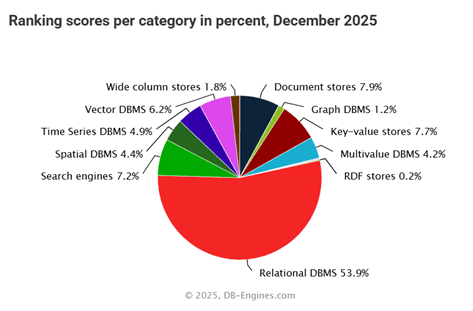
Distribution of databases by category – December 2025 (DB-Engines)
The rise of specialised databases: The fuel for Stages 4 and 5 (AI & GenAI)
This relative decline in relational databases can be explained by the rise of databases that meet the requirements of AI:
- Vector databases (6.2%) and time series databases (4.9%) are growing.
- Why? Because they are essential for feeding predictive algorithms (AI analysis) and semantic search engines necessary for generative AI.
36-month trend: The end of ‘all or nothing’
A market undergoing gradual restructuring
The three-stage analysis shows that ‘traditional’ relationship foundations (index 90 at the end of 2025 vs. 100 at the beginning of 2023) are giving way to innovation without disappearing altogether.
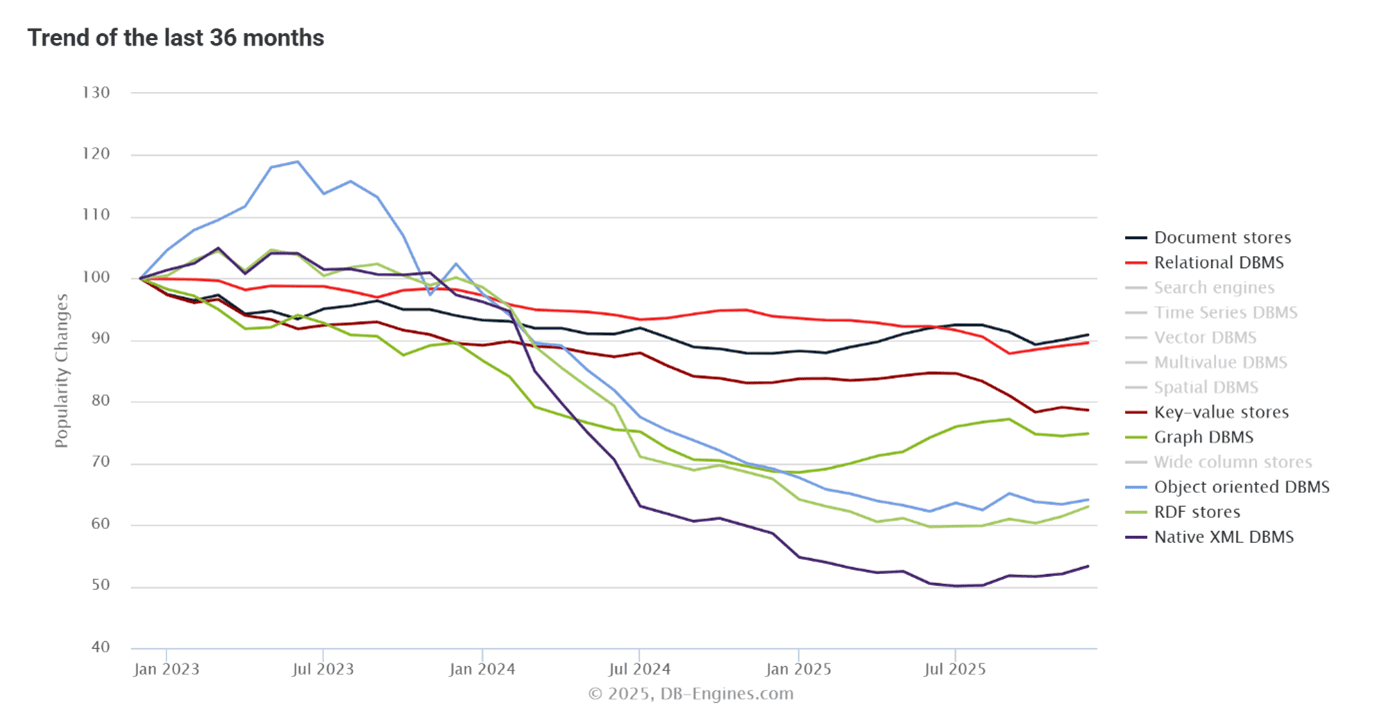
A redistribution for the AI Factory
The decline of certain niche technologies (XML, RDF) in favour of more versatile solutions (document stores, search engines) illustrates the transition to stage 6: the AI Factory. Companies are no longer seeking to accumulate technologies, but to build ‘composable’ and efficient architectures, where the old (SQL) and the new (NoSQL/Vector) coexist to accelerate the production of models.
12-month evolution: Strong signals from Generative AI
This is where the impact of AI is most visible. Recent developments directly validate the importance of Stage 4 (Using Generative AI).
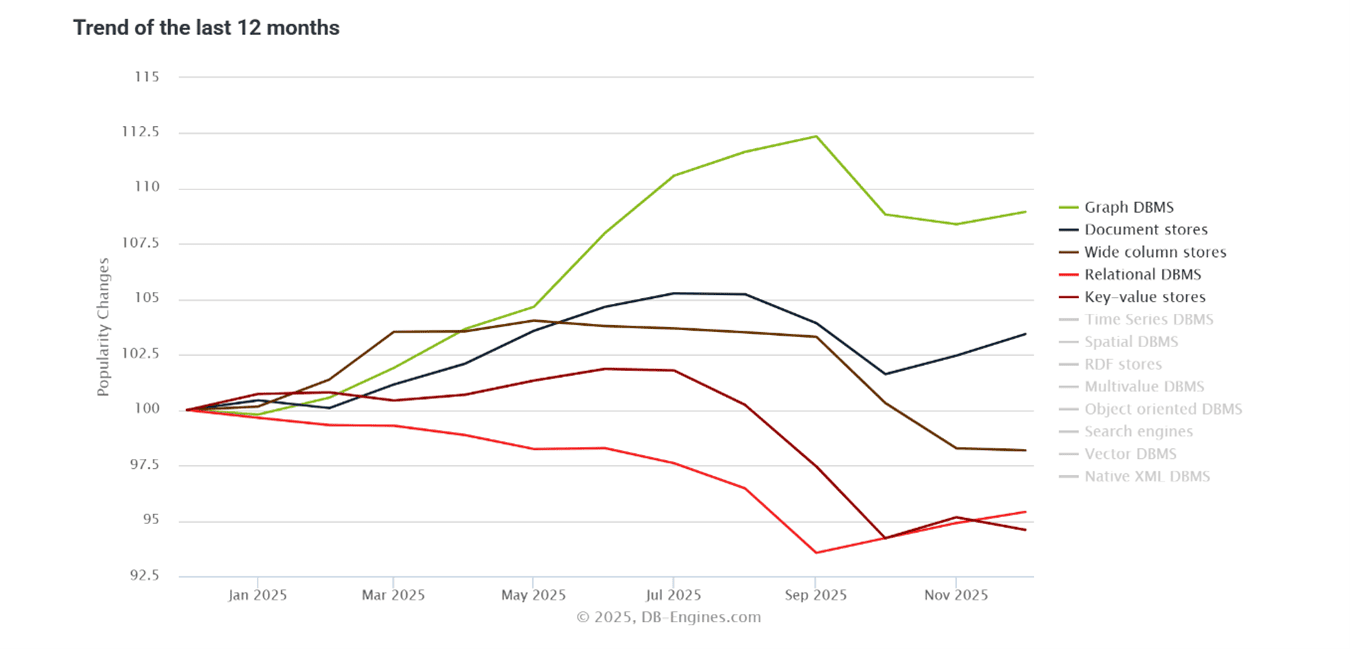
Graph-oriented databases: +12% to give context to AI
Over the last 12 months, graph databases have exploded (+12%). This is no coincidence. Graph databases are essential for RAG (Retrieval-Augmented Generation), the technique that makes Generative AI accurate and contextual in business. It is the direct technical link between your data and ChatGPT.
Resilience of document stores and decline of ‘key-value’
Document stores are holding steady, confirming their role in the agile architectures required for modern applications. Conversely, the decline of key-value databases shows a refocusing on use cases with higher added value.
Conclusion: Don't just accept database rankings, use them to move forward!
The DB-Engines 2025 ranking sends a clear message: the market is becoming hybridised to support AI. Relational databases remain your safety net (Administration), but graph and vector databases are your future (Generative AI and Analysis).
Choosing a database is no longer an isolated act; it is the first step in a six-step journey towards a data-driven enterprise.
Wondering if your architecture is ready to mature in terms of data and AI?
DEEP supports you from the management of your historical databases to their enhancement through AI.

Written by
Rémi DUSAUD
Head of Consulting Services
Related articles

Why Is Oracle AI Database 26ai a Game Changer for Unlocking Value from Your Sensitive Data
Discover Oracle AI Database 26ai: integrated generative AI, vector search, converged architecture and secure on-premise data management.
Published on
13 March 2026
Top 10 databases: Is your architecture AI-ready?
The DB-Engines Top 10 for December 2025 confirms the hybridisation of SQL, NoSQL and graphs. Analysis of trends in data, generative AI and maturity towards the Data-AI Factory.
Published on
25 February 2026

EBS migration to OCI: your checklist
Download our checklist of 5 critical points to audit before launching a tender or project.
Published on
22 January 2026


Our experts answer your questions
Do you have any questions about an article? Do you need help solving your IT issues?