

Ignite 2026: The technology is ready. Are organisations ready?
AI, Cybersecurity, FinOps and the challenge of staying in control. A Luxembourg perspective.
DEEP is back from Microsoft Ignite 2026 with a wealth of announcements to reflect on. New capabilities, new agents, new platforms and an increasingly integrated infrastructure. But simply listing the latest developments would ultimately add little value. The Microsoft Ignite 2026 | Book of News already does that, and far more comprehensively.
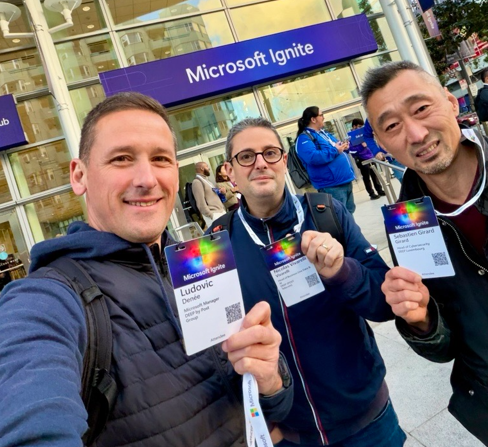
This edition also had a particular significance for DEEP: three of us attended, each bringing a different perspective. Sébastien Girard from Cybersecurity, Nicolas Vivarelli from Data & AI, and Ludovic Denée, offering a broader view of the Microsoft ecosystem and its transformation.
Three perspectives, different sessions and announcements viewed from different angles. Yet, throughout our discussions, one shared conviction emerged: these topics can no longer be addressed in isolation.
The real question, therefore, is not which announcement will prove to be the most significant. It is about understanding what this convergence means for businesses, particularly in a market like Luxembourg, where innovation must go hand in hand with high standards of trust, regulation and accountability.
1. Agents are moving beyond the lab
We are no longer talking solely about assistants that generate content. We are now talking about systems capable of understanding context, using tools, accessing data, collaborating with other agents and progressively taking action within operational processes.
This is where our three perspectives began to converge. From a Data & AI standpoint, the question might be: What can we now delegate? From a Cybersecurity perspective: What should we allow an agent to do, with which identity, which data and what boundaries? And from a broader Cloud and Operations perspective: How can we make all of this work reliably, observably and at scale?
The shift from copilots to agents is therefore not simply a technological evolution. It is a shift from assistance to delegation.
And this shift also changes the nature of risk. The more a system can act, the greater its reach and the potential impact of an error. The question is no longer simply what an agent can do, but how far we are prepared to let it go and how we retain the ability to limit its impact. Ultimately, any delegation requires a mandate, permissions, boundaries and, above all, an accountable owner.
2. The Luxembourg perspective: evidence before promises
This is where this convergence takes on particular significance for Luxembourg. The Luxembourg market is not opposed to innovation. It simply expects concrete answers very quickly:
-
Where is our data stored, what is its quality and who is responsible for it?
-
Who, human or agent, can access it and under what conditions?
-
Can we understand and audit the decisions and actions taken?
-
Who controls costs and measures the value generated?
-
What happens when a system operates outside its intended scope or when a provider becomes unavailable?
-
Are we able to limit the impact and maintain essential business functions?
In an environment subject to stringent regulatory requirements, these questions are far from theoretical. CSSF Circular 25/882 is notably part of the regulatory framework governing the use of third-party ICT services by financial entities subject to DORA.
Trust can therefore no longer rely solely on our ability to prevent an incident. It also depends on our ability to detect when a system moves outside its intended scope, limit the consequences and maintain the organisation's essential functions.
The question is becoming less about: Is it secure? And more about: Can we stay in control when something goes wrong?
Ultimately, a week like Microsoft Ignite 2026 encourages us to look at things from a different angle.
What if this culture of trust and control, sometimes perceived as caution, actually became an advantage in the age of AI?
A market accustomed to asking Where is my data? Who can access it? Can I audit it? Who is accountable? is already raising many of the questions businesses will need to answer before deploying AI at scale.
This could represent a particular opportunity for Luxembourg. If we can build AI that is governed, resilient, economically controlled and explainable in one of Europe's most demanding environments, this capability could become a genuine differentiator, extending well beyond our borders.
3. The more AI acts, the clearer the human role must become
This is probably one of the most striking paradoxes of this edition. We spent several days discussing increasingly autonomous systems. And yet, the more autonomous these systems become, the more important the human dimension becomes.
The expression human in the loop comes up frequently. But it can also be misleading. Being "in the loop" does not simply mean clicking Approve when a system asks for it.
It means understanding:
-
what has been delegated;
-
which data and information have been used;
-
on what basis a decision is made and whether it can be explained;
-
which actions the system is authorised to take;
-
under what circumstances a human must take back control;
-
and, above all, who remains accountable for the final outcome.
We therefore need to distinguish between several levels:
-
Human in the loop: A human validates the action before it is executed.
-
Human on the loop: The system operates within a defined framework, while a human supervises it and can intervene.
-
Human accountable for the loop: The system can execute a significant part of the process, but responsibility for that process remains explicitly human.
We believe this last dimension is fundamental. Technological autonomy must never create ambiguity around human accountability. This is also where Cybersecurity and Data & AI truly stop being two separate conversations.
Security can no longer be a checkpoint at the end of an AI project. Its role must evolve: not to prevent delegation, but to create the conditions that allow us to delegate more without losing control. The more autonomy we give a system, the clearer its mandate, boundaries and the conditions for reducing or withdrawing that autonomy must be.
Cybersecurity thus becomes an enabler of trust, allowing organisations to move from: We can build it
to: We can rely on it safely.
Perhaps the real question is no longer how far AI can go, but how far we want to let it go and what responsibilities must remain explicitly human when part of the action is delegated to technology.
4. FinOps: the moment of truth
Another dimension is set to become a key factor very quickly. During the AI experimentation phase, the main question was essentially:
Can we do it?
When it comes to industrialising AI, another question emerges:
Should we scale it?
Governance defines what an agent is allowed to do. Cybersecurity helps determine the conditions under which we can trust it and remain in control. Operations determine whether it can run reliably and sustainably. And FinOps must help determine whether it is actually worth doing.
FinOps is therefore set to play a major role in this new phase. Microsoft itself positions FinOps for AI around collaboration between engineering, finance and business teams to understand and optimise not only AI-related spending, but also the value generated.
And this point matters: FinOps for AI should not simply be about reducing the AI bill. It should help us understand the economics of intelligence.
This also means defining the right metrics before scaling:
-
Value: What business outcome does the agent actually improve?
-
Usage: Is it actually being used, and by whom?
-
Cost: How much does each execution or automated process cost?
-
Quality: Does the outcome justify the cost?
-
Risk: What would be the impact of an error or incorrect action?
-
Trade-offs: Do we really need the most powerful model for this task?
-
Accountability: Who can modify, suspend or stop the system?
This evolution fundamentally changes the way we approach FinOps. It is no longer simply about optimising VMs, storage or underutilised resources. We will increasingly need to be able to relate the cost of a unit of intelligence to the value it generates.
But this equation must also take risk into account. Two agents delivering the same value do not necessarily have the same risk profile. One may simply recommend an action, while the other can execute it directly within a critical process.
The same value, the same cost, but a radically different level of exposure. The equation therefore becomes: Value × Cost × Risk. And this will require Finance, IT, Cybersecurity, Data & AI and business teams to speak a much more common language.
5. Convergence: perhaps the real message from Ignite
Sébastien, Nicolas and Ludovic's participation in Microsoft Ignite 2026 ultimately made it possible to observe the same transformation through three complementary lenses: Cybersecurity, Data & AI and the Microsoft ecosystem as a whole. Throughout the week and our discussions, the boundaries between these disciplines gradually began to blur.
This cross-functional perspective brings a few simple questions to the forefront:
Data & AI: Can we build it?
Cybersecurity: Can we control it?
Cloud & Operations: Can we make it run reliably?
FinOps: Does it create sustainable value?
And at the centre:
Human accountability: Should we delegate, and who remains accountable?
Perhaps this is ultimately the most important shift. AI can no longer be just a conversation within Data & AI. Security can no longer be a checkpoint. Cloud can no longer be discussed without involving Finance teams. And FinOps can no longer be limited to talking about infrastructure costs. These disciplines are beginning to form a single, interconnected system. And the human dimension is not disappearing. On the contrary, it is becoming the point where everything converges.
With agentic AI, the security challenge is ultimately no longer just about protecting technology. It is about retaining control over a system to which we are progressively giving the power to act.
Conclusion: moving forward without losing control
The main takeaway from our participation in Microsoft Ignite 2026 is therefore not that we need to move faster at all costs.
The complementary perspectives of Séb, Nico and Ludo instead highlight the conditions required to scale successfully: enough trust to industrialise, enough governance and Cybersecurity to control the reach of increasingly autonomous systems, and enough economic discipline to turn experimentation into sustainable value.
Behind all these dimensions lies one fundamental question: How far do we want to delegate, and what responsibilities must remain explicitly human?
This may be where Luxembourg has a particular advantage. The need for trust, control, resilience and compliance does not necessarily have to be seen as a barrier to innovation. On the contrary, it can become one of the conditions that make sustainable deployment possible. The challenge may not be to move faster, but to go further without losing control along the way.
And what do you see as the main challenge in moving from experimentation to large-scale AI deployment within your organisation today: trust, governance, costs or human accountability? Share your perspective and experience: this is a discussion that deserves to bring different viewpoints together.


Our experts answer your questions
Do you have any questions about an article? Do you need help solving your IT issues?