
EBS to OCI: Which migration strategy should you choose? A guide for decision-makers - DEEP
EBS to OCI: Which migration strategy should you choose? A guide for decision-makers
22 January 2026
You have validated the destination: Oracle Cloud Infrastructure (OCI). Indeed, 2026 is a pivotal year to migrate your EBS to OCI. However, the journey to get there offers several possible routes.
Choosing the wrong migration method can turn a strategic project into a technical quagmire, with all the consequences that follow (budget overruns, service disruptions, etc.). But choosing nothing also means missing an opportunity to modernize.
Between the speed of Lift & Shift, the necessity of an Upgrade & Migrate approach, and the power of Replatforming (Exadata), there is no single “best” choice in absolute terms - only the choice that best fits your context.
This short guide will help you decode these three strategies for your Oracle E-Business Suite environment.
1. “Lift & Shift”: The fast track
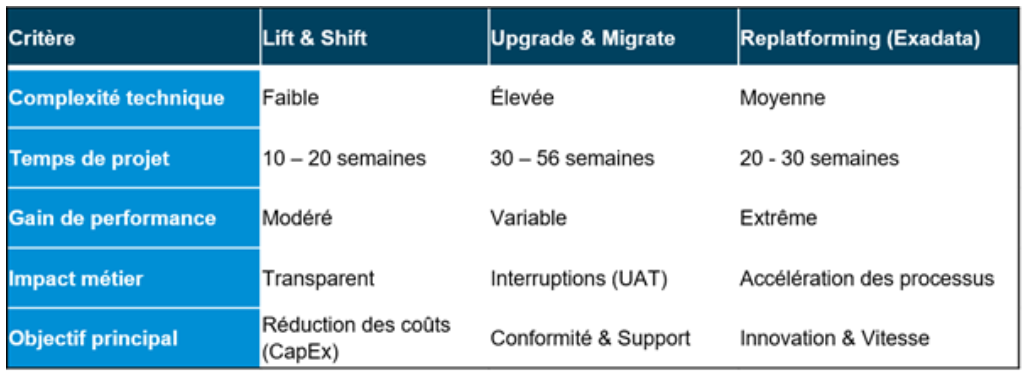
This is the most straightforward approach, and the most attractive if your primary objective is cost reduction. You take your current architecture (VMs, OS, Database, Application) and move it as-is to OCI, without modifying the application. It is therefore an infrastructure change, not an architectural one.
- Ideal scenario if: You want to validate the Cloud without touching the application layer, or you need to exit a data center quickly (end of lease, critical hardware failure). You immediately benefit from the elasticity and availability of the cloud.
- Benefits: Moderate migration cost, immediate savings, minimal effort, reduced service interruption.
- Project duration: 10–20 weeks. This is the fastest migration; the production cutover takes place in just a few hours.
- Main drawback: You move your technical debt. If your EBS is slow on-premises, it will (probably) be slow in the cloud—unless the underlying hardware is radically better.
- Required skills: OCI infrastructure, Oracle tools (EBS Cloud Manager, ZDM).
Verdict: Lift & Shift is ideal as a first step toward the cloud, but it is not an end in itself. Once on OCI, you can modernize at your own pace.
2. “Upgrade & Migrate”: Bringing everything up to standard
This strategy combines relocation with a major upgrade, typically moving from EBS 12.1 (or earlier) to version 12.2, along with an upgrade of the database to 19c.
- Ideal scenario if: Your current version is no longer supported (or extended support is too expensive), and you need the new functional features of 12.2. You modernize your EBS while migrating to OCI.
- Benefits: You land on a clean platform with the latest EBS and Oracle DB features, delivering medium-term ROI through improved performance. You are set for the next 10 years, with a version supported until 2036.
- Project duration: 30 to 56 weeks, depending on the complexity of customizations and the required testing.
- Main drawback: Complexity. You manage two simultaneous change variables (Infrastructure + Application). Regression testing must be exhaustive and requires business validation of the new versions.
- Required skills: Functional and technical EBS expertise, Oracle DB upgrade expertise, OCI skills.
Verdict: Essential if you are still on 12.1 or an earlier version. It is a complex project, but the only one that guarantees long-term sustainability.
3. “Replatforming” to Exadata Cloud Service: Pure performance
Do you want to gain speed and develop innovative projects (AI)? This is where OCI delivers the greatest business value. You migrate the application to virtual machines, while moving the database to Exadata Cloud Service.
- Ideal scenario if: Your EBS is the beating heart of the company. You suffer from slow financial closes, payroll processing, or supply chain operations. Your IOPS (input/output operations) are saturated.
- Benefits:
-
Extreme performance: Exadata is specifically designed for Oracle databases (Smart Scan, intelligent caching).
-
Reduced administration: Less time spent on tuning and hardware maintenance.
-
Consolidation: You can often consolidate multiple databases on a single Exadata, reducing license costs.
-
- Project duration: 20–30 weeks, with additional time required for Exadata optimization and tuning.
- Main drawback: Higher initial cost (although TCO is often better thanks to consolidation), and it requires architectural adjustments to fully leverage Exadata Cloud Service.
- Required skills: Exadata expertise and advanced DB optimization skills, Oracle cloud architecture, EBS performance expertise.
Verdict: If performance is your number-one priority, this is the most serious option. It is the qualitative leap that justifies the project to the business.
Quick comparison guide:
Conclusion: What is your ambition for 2026?
It is essential to align your migration strategy with your business objectives. Technical constraints can always be overcome with the right partner.
- If you need to reduce costs immediately: Go for Lift & Shift.
- If you need to secure vendor support: Launch an Upgrade & Migrate.
- If you want to give your operations a competitive edge: Dare to Replatform on Exadata.
The good news? On OCI, nothing is set in stone. You can start with a “Lift & Shift” to secure your data, then move your database to Exadata six months later. The key is to take the first step.

Written by
Thierry LOUBES
Head of Business Line Cloud France