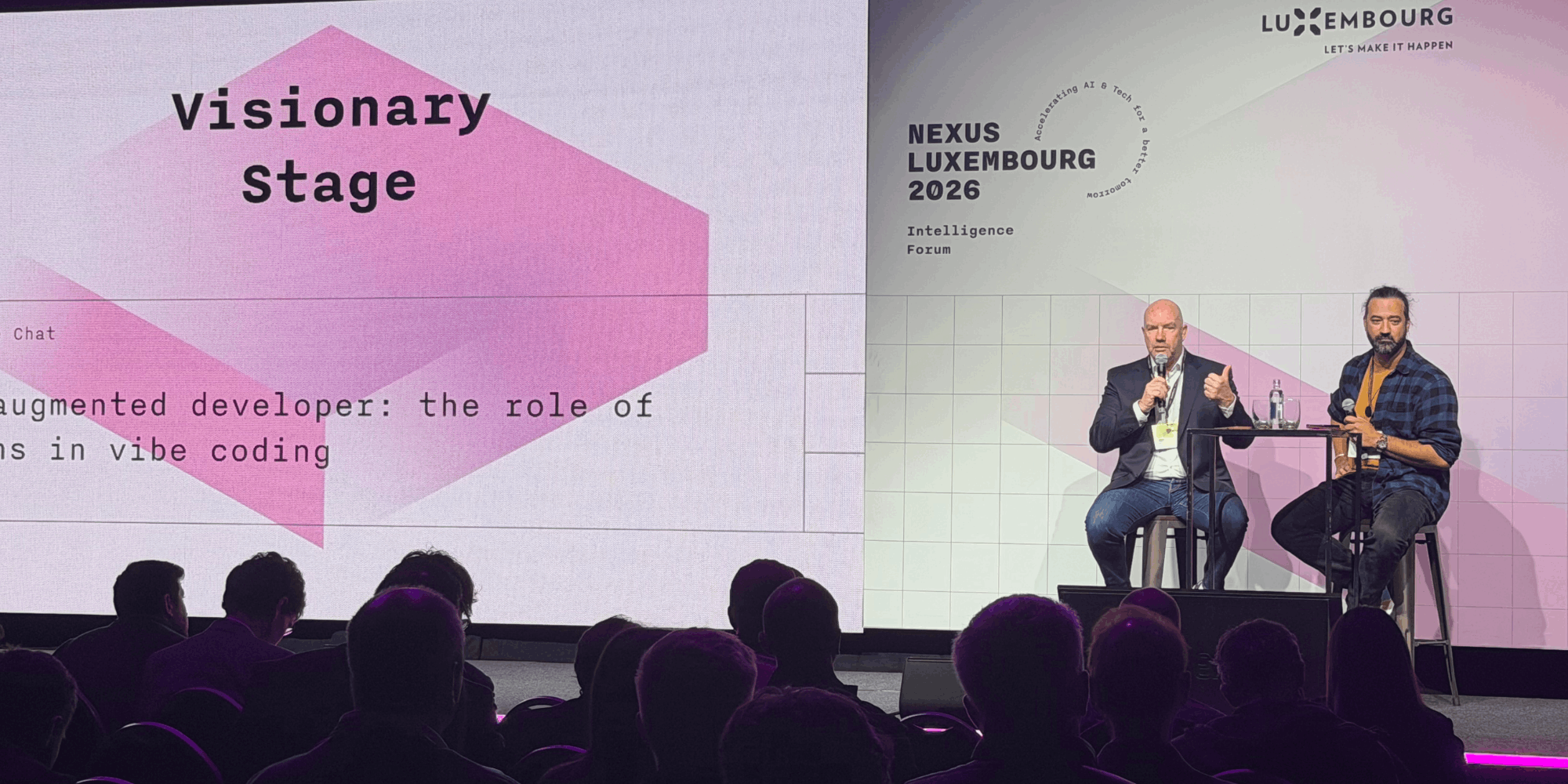
The rise of coding assistants and AI agents is already reshaping the daily work of development teams. But beyond individual productivity gains, the entire software development lifecycle is undergoing a profound transformation. During the Nexus event, I had the pleasure of speaking with Lucien Loiseau (OVHcloud) to share our common vision of a new generation of organizations, where artificial intelligence becomes a true partner in software design and production.
With the adoption of AI, our professions are evolving significantly. The capabilities of AI-powered coding assistants continue to improve, giving rise to a new way of developing software: Vibe Coding. Thanks to these tools, employees can now generate complete applications, write high-quality code, and fix errors using only a few instructions written in natural language. However, behind these impressive demonstrations lies a much deeper transformation. The challenge today is no longer simply to speed up developers' work, but to rethink how organizations create and leverage software.
The Developer No Longer Writes Code, They Define Intent
In our industry, everything is moving at an incredible pace. Lucien Loiseau told me that while AI generated around 10% of his code a year ago, that proportion is now approaching 100%. Nevertheless, I remain convinced that the developer's role is not disappearing; it is evolving into a more strategic position.
Modern development agents do much more than generate isolated lines of code. Today, they can execute, test, correct and improve their own output to achieve a specific objective. Developers now intervene more upstream and downstream: defining the vision, setting objectives and validating results. As with every major technological evolution, the level of abstraction increases. After high-level programming languages and frameworks, we are now working directly from our intentions. Our new programming language has simply become natural language (or English).
Productivity Multiplied...
The productivity gains we are witnessing in the field are considerable. Depending on the context, a developer can now accomplish in a few hours what previously required several days of intensive work. I believe there is currently potential to increase a developer’s personal productivity by a factor of three, five, or even ten in specific cases, particularly for small-scale projects and proof-of-concepts.
This opens up entirely new possibilities. Where an entire team was once required to deliver a project, a smaller number of people will soon be able to supervise a true army of specialized agents. This evolution significantly democratizes access to custom software development and represents a major opportunity for smaller organizations.
Technical Debt Is Not Disappearing
However, we must remain realistic: today’s AI systems are still imperfect. They make mistakes, occasionally take unfortunate shortcuts and do not always have a complete understanding of complex business contexts. If left unsupervised, technical debt and cognitive debt can increase exponentially.
In other words, producing software faster does not guarantee producing better software. Our role as developers and architects is therefore to maintain overall consistency, rigorously validate decisions and preserve system quality over time.
The Real Challenge: Transforming Organizations
Given these transformations, I believe the most interesting question is no longer individual productivity. Today, we should ask whether it is possible to reproduce these productivity gains—already achieved within software projects—across entire organizations.
Instead of adapting our processes to standardized software solutions, could we not, in the future, create applications that are perfectly tailored to every business context much more easily?
For me, the fundamental objective is not simply to move faster, but to enable companies to develop a multitude of solutions precisely aligned with their operational needs. Naturally, this requires new ways of working, processes designed from the ground up for AI agents, and governance frameworks that allow teams to collaborate effectively with these new tools.
From Individual Productivity to Collective Performance
Beyond code generation itself, we will see the emergence of agents capable not only of developing software but also of directly executing certain business functions. Marketing, finance, operations and project management departments will increasingly rely on specialized agents working together to achieve objectives defined by human teams.
This is precisely why we created Breign: an accelerator designed to help business teams deploy AI more effectively.
Conclusion
Generative AI is no longer simply assisting developers in their everyday tasks. It is fundamentally changing how software is designed, produced and maintained.
For businesses, the challenge is no longer just to save time, but to learn how to orchestrate this new relationship between humans and intelligent agents in order to create lasting value.