
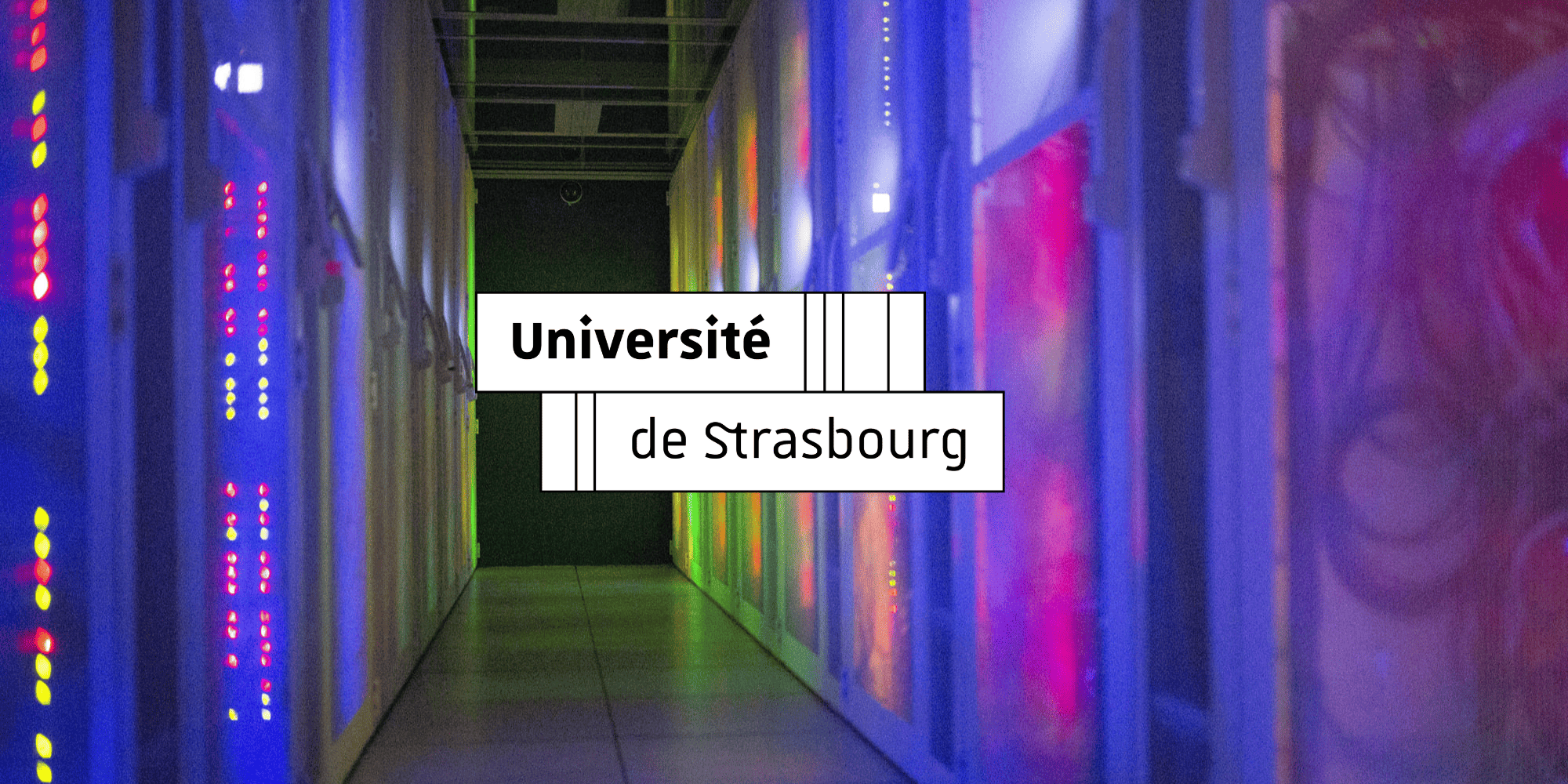
Building a sovereign, high-performance and sustainable datacenter: the successful challenge undertaken by the University of Strasbourg to support academic excellence and scientific research.
Located at the crossroads of France, Germany and Switzerland, the University of Strasbourg (Unistra) is a major hub for academic education and research in Europe. Unistra enjoys a strong international reputation thanks to its extensive academic offering and research programs with cross-border influence. Each year, it welcomes nearly 50,000 students, includes 2,000 teacher-researchers and employs around 3,000 staff members. The University of Strasbourg is one of the largest multilingual and multicultural universities in France. More than 20% of its students come from 156 different nationalities, while its staff represents over 80 nationalities.
A New Datacenter to Support Academic Excellence
To address growing IT requirements essential to a demanding academic environment, Unistra’s Digital Department decided, as early as 2013, to position its datacenter as the technological backbone of the institution.
“Following the merger of Strasbourg’s three universities in 2008–2009, we began a process to rationalize and secure our information system,” explains Pascal Gris, Head of the Infrastructure Department at Unistra. “We started from a fragmented environment made up of small IT rooms developed over time according to evolving needs, with environmental and security systems that were no longer appropriate.”
These heterogeneous infrastructures no longer met the institution’s requirements and exposed it to significant risks: lack of agility in digital services, operational risks and data security challenges, energy inefficiency, and difficulties in supporting the growth of academic and research activities.
Relying on an Experienced Partner
“Research activities, in particular, require reliable infrastructure and significant computing power that is flexible and scalable. That is why we initiated a structured reflection around the creation of a modern datacenter,” continues Pascal Gris.
Following a public tender for project management assistance, Unistra selected the services of DEEP, whose reputation for operating its own datacenters has largely extended beyond Luxembourg, where the company operates three Tier IV-certified sites.
“The choice of DEEP was mainly driven by their experience as datacenter operators,” continues the manager. “More than consultants, we placed our trust in practitioners capable of turning principles into operational realities and who truly understand the challenges of sovereign infrastructure.”
Thanks to this ability to combine strategic vision with field expertise, DEEP supported the university at every stage of the project:
- datacenter design
- project management supervision
- strategic technological and operational choices
- additional missions, including key certification, optimization and evolution phases

An Implementation Driven by Three Priorities
The project was built around three fundamental pillars:
1. Availability and Resilience
“To guarantee service continuity, we relied on redundant systems, at a minimum N+1 and even 2N in some cases,” explains Pascal Gris. This approach ensures a high level of availability, essential for the university’s critical activities and its broader ecosystem.
2. Energy Performance and Innovation
Energy-related challenges were considered a priority from the design phase onward.
“The datacenter was commissioned in 2019, well before the recent energy crises or the rise of AI. Our sense of responsibility led us to make energy consumption management a central issue. We therefore prioritized low-energy technologies, particularly a geothermal cooling system,” says Pascal Gris.
These energy-efficient technologies provide the cooling required for servers while also enabling the recovery and reuse of the heat generated by them, notably for heating buildings.
This innovative approach earned Unistra a European Code of Conduct Award in 2019 for the quality of the project and its energy efficiency.
3. Data Sovereignty
“Ensuring control over services and data sovereignty also appeared as a key challenge from the very beginning,” highlights Pascal Gris.
Choosing an internal datacenter therefore became a strategic alternative to the public cloud.
“By managing the infrastructure ourselves, we protect research data, reduce dependency on third-party providers and maintain full governance over our environments,” continues the Head of Infrastructure.
A Foundation Serving a Broad Ecosystem
This exceptional infrastructure, entirely managed by the University of Strasbourg, addresses needs that go far beyond the institution itself.
“We operate within a shared-services logic serving the higher education and research ecosystem at a regional level and, in some cases, public-sector organizations,” explains Pascal Gris.
This mutualized approach optimizes costs across the ecosystem while supporting territorial collaborations.
Concrete and Sustainable Results
Since its commissioning, the datacenter has become a strategic lever for Unistra, delivering tangible benefits:
- high availability of IT services
- advanced energy management
- national recognition (label awarded by the French Ministry of Higher Education)
- ability to deliver innovative cloud services based on IaaS and PaaS
- controlled openness to external partners
“The project significantly contributed to transforming the organization, particularly the IT services,” says Pascal Gris. “We completely redesigned the department to align with cloud models and service offerings in order to better support research needs.”
A Long-Term Collaboration
More than ten years after the first collaborations, the partnership between the university and DEEP continues.
“We greatly appreciate working with DEEP’s teams and benefiting from advice grounded in concrete operational experience and a clear understanding of the sector’s evolution,” explains Pascal Gris.
Today, the partnership between Unistra and DEEP continues around several key challenges for the institution:
- obtaining certifications, notably ISO 27001 and ISO 50001
- datacenter evolution projects to address continuously growing needs
- continuous pursuit of environmental performance and optimization
Outlook: AI, High Density and New Architectures
The evolution of usage, particularly with the rise of artificial intelligence, is creating new challenges.
“GPU servers, which provide the computing power required for new applications, are particularly energy-intensive. As a result, the current cooling model could reach its limits in the medium term. We therefore need to anticipate these developments.”
Together with DEEP, several areas are currently being explored:
- advanced liquid cooling (DLC, immersion cooling)
- deployment of infrastructures adapted to very high densities
- evolution toward hybrid architectures
At the same time, initiatives are emerging around measuring the carbon footprint of digital services, integrating the entire value chain (infrastructure, network, usage), an area in which DEEP can already demonstrate solid expertise.
An Exemplary Partnership
“This project illustrates a comprehensive approach combining strategic vision, technological expertise and environmental innovation,” concludes Pascal Gris. An inspiring model for organizations facing the growing challenges of data management, energy efficiency and digital sovereignty.
Université de Strasbourg
