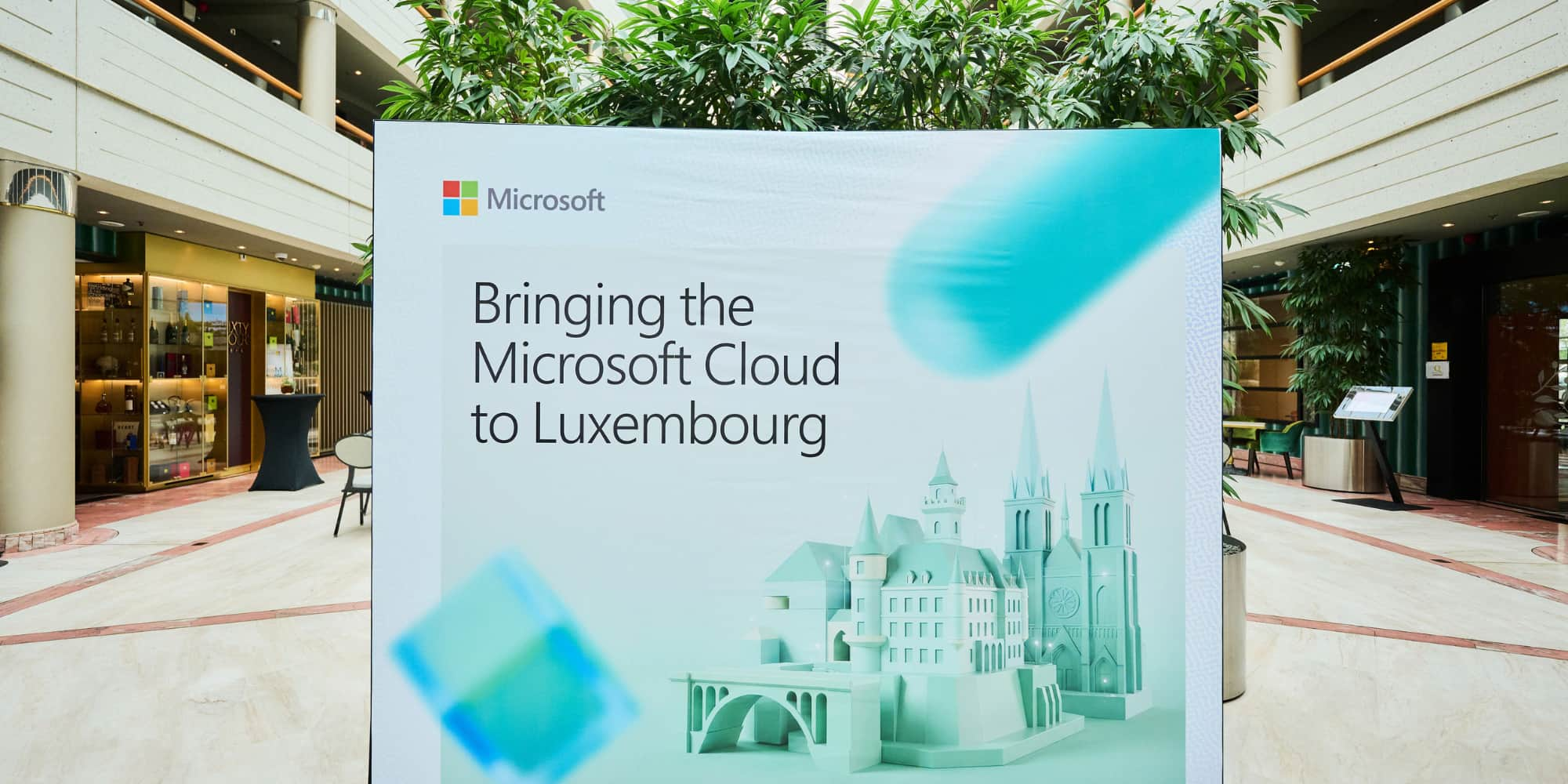
In previous articles, we explored how the Azure Extended Zone Luxembourg expands cloud architecture possibilities by bringing infrastructure closer to users, providing local data residency and reducing latency for certain workloads. But for many organisations in Luxembourg, particularly in regulated sectors, another question is just as important:
How can this new infrastructure be leveraged while maintaining a high level of security and compliance?
The Azure Extended Zone adds another option to consider: running certain Azure workloads and keeping certain data in Luxembourg, while remaining integrated with the Microsoft Azure ecosystem.
However, it does not replace a security strategy or governance model. On the contrary, its arrival is an opportunity to put Zero Trust principles back at the heart of cloud architecture design.
Data location is only part of the equation
Data residency is, of course, an important consideration for many organisations.
The Azure Extended Zone Luxembourg makes it possible to host certain workloads and data locally. The environment is based, among other things, on a selection of Azure compute, storage and networking capabilities.
But knowing where data is located does not answer every security question.
It is also necessary to determine who can access it, from which device, through which network, how the data is encrypted, how actions are logged and how incidents are detected.
This is precisely the approach advocated by the Zero Trust model: never automatically consider a user, device or traffic flow trustworthy simply because it is in a particular location.
Applying Zero Trust principles
An architecture using the Extended Zone must therefore be integrated into the organisation’s overall security strategy.
This involves several fundamental principles.
Explicitly verify access
Identities and their associated permissions must remain at the heart of the security framework. Microsoft Entra ID, multifactor authentication and Conditional Access policies can, for example, be used to apply controls based on the access context.
Apply the principle of least privilege
A user, administrator or application should only have the permissions required to perform its function. Privileged access must be particularly well controlled and monitored.
Segment environments
Geographical proximity should not lead to simplified network rules. Segmentation, traffic filtering and control of communications between workloads remain essential.
Protect and monitor workloads
An effective security strategy also requires visibility into configurations, vulnerabilities and security events.
The question is therefore no longer simply: “Is my data in Luxembourg?”
It becomes: “Who can access this data, how is it protected and how can I demonstrate this?”
Compliance: start with the workload requirements
It would also be too simplistic to assume that hosting an application in Luxembourg automatically makes it compliant.
Compliance depends on the context of each organisation, the nature of the data being processed, the applicable regulations and the architecture implemented.
Nevertheless, the Extended Zone provides an additional location option, particularly relevant when data residency is one of the identified requirements.
In sectors such as finance (DORA), the public sector or critical infrastructure (NIS2), this option can form part of a broader risk management and compliance strategy.
Security by design
One potential pitfall would be to view the Extended Zone simply as infrastructure to which an existing workload can be moved without reassessing its architecture.
On the contrary, this is the right time to adopt a security-by-design approach.
Before migrating, several questions should be considered:
- What data does the application process?
- Where does this data need to be stored?
- Which users and services need access to it?
- Which traffic flows need to enter or leave the Extended Zone?
- Which dependencies remain hosted in an Azure region?
- Which security events need to be logged and monitored?
- How should privileged access and technical accounts be managed?
- What business continuity and disaster recovery strategy should be applied to the workload?
This analysis helps avoid reproducing the weaknesses of a legacy architecture in the cloud.
A new component of the cloud security strategy
The Azure Extended Zone Luxembourg is therefore not, on its own, an answer to security or compliance challenges.
What it provides is something different: an additional option for designing architectures that combine proximity, local residency for certain data and the capabilities of the Azure platform.
The challenge now is to integrate this new option into the security and governance frameworks already in place within organisations.
And when security, identity, networking, data and governance are considered together, the Extended Zone can become a coherent new component of the cloud strategy.
One final question remains: how do you move from consideration to a first concrete workload?
That is precisely the topic of our next article.